RESEARCH & DEVELOPMENT

Build with care.
Keep asking.

Our aim is a more approachable musical experience. An engineering prototype is a beginning; understanding real use is work ahead.

Xunova has not been shown to improve core autism symptoms. It is not for diagnosis, treatment or replacing professional care. Here we distinguish design hypotheses, existing engineering work and planned evaluation.

01 / OUR DESIGN HYPOTHESIS

Could a clearer next step
make starting easier?

Reading a score, remembering fingering, coordinating hands and controlling breath can ask for attention at the same time.

We are exploring whether light cues, an adjustable breath threshold and stepwise tasks can reduce the demands of getting started. This is a hypothesis to test, not a description of every autistic child. Sound preferences differ too, which is why sample replacement is part of the design.

Explore the intended settings ↗

02 / RESEARCH THAT INFORMS US

Evidence, with
clear boundaries.

Related research helps us ask better questions. It does not validate or endorse Xunova.

COCHRANE / 2022

Music therapy evidence is not instrument efficacy.

Cochrane’s review of music therapy for autistic people concerns full music therapy interventions. It provides context for our interest in musical participation, but its findings cannot be transferred directly to Xunova. Usability and any potential benefit require product-specific research.

Read the Cochrane review ↗

DOI: 10.1002/14651858.CD004381.pub4

NICE / CG170

Begin with individual preferences.

NICE guidance considers visual support, individual sensory sensitivities, and the preferences of children and their families. This informs our exploration of clear cues, adjustable settings and choice. Whether particular lights, sounds and grip arrangements are suitable still needs evaluation with each person and setting.

Read the NICE guidance ↗

03 / CURRENT ENGINEERING WORK

A prototype to test.
Details to keep improving.

The work below is represented in the current source code, models and physical records. A capability in code does not mean every unit has passed a reliable hardware test.

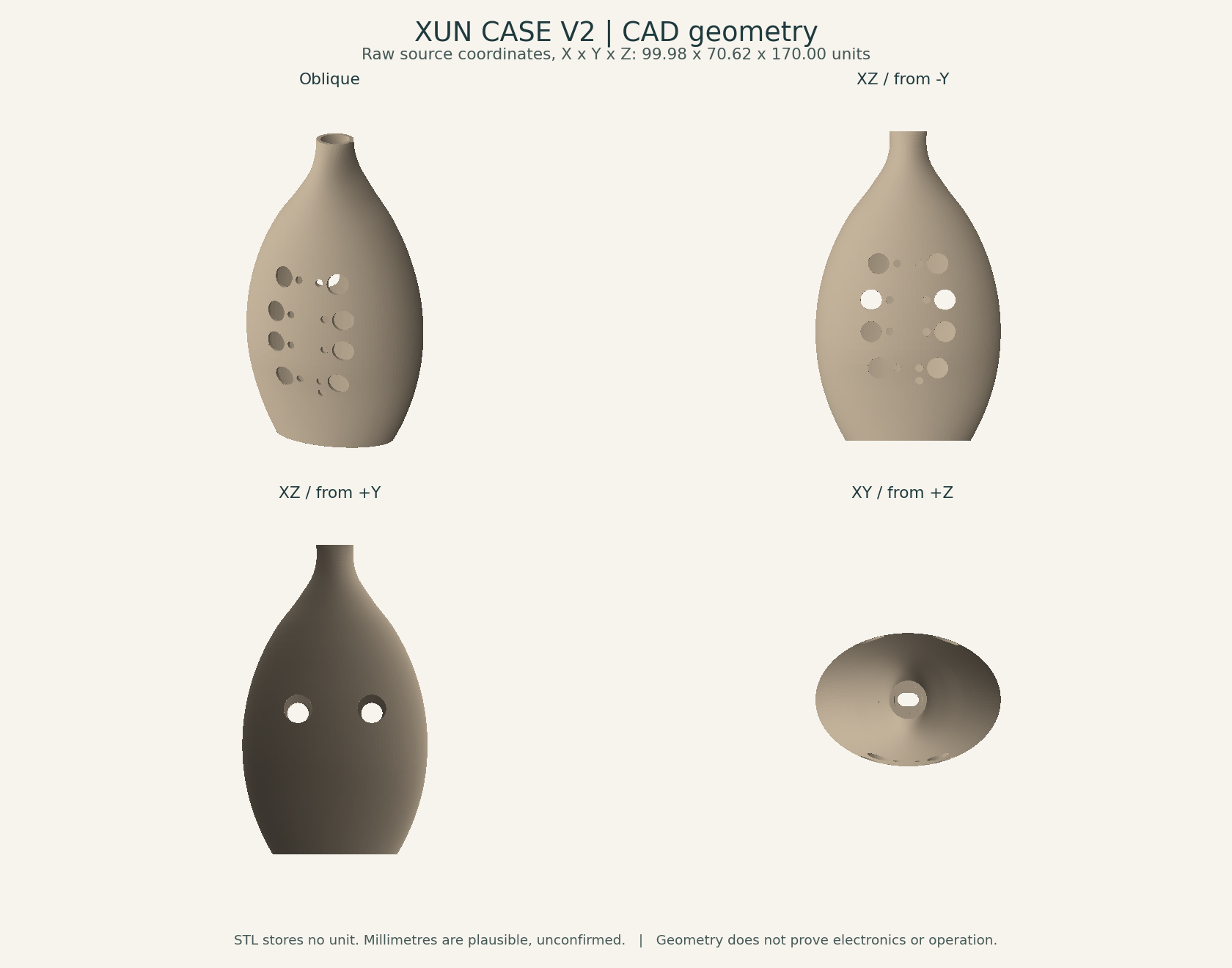
Xunova CAD views showing shell and internal structural development
Actual CAD development record · A design iteration, not proof of a finished production unit. Model and physical contact / light numbering still need alignment.

INPUT & FEEDBACK

Touch, breath and light.

A classic ESP32 reads 11 MPR121 touch inputs, E0–E10, and a differential pressure sensor. Eleven LEDs cue the target combination; the firmware checks exact fingering and a new breath against the task conditions.

AUDIO & CONTROL

Samples on the device. Controls on the page.

Twenty pitch-specific WAV samples are stored in Flash and played through I²S and a MAX98357A amplifier. BLE / Wi-Fi carries controls and status. Current code includes single-note, self-paced, cumulative, rhythm and free-play modes.

04 / PLANNED EVALUATION · NOT RESULTS

Let experience answer.

First verify notes, repeated notes, audio, stopping and reconnection. Then plan small usability observations with professional guidance, guardian consent and respect for the child’s assent.

Are the cues clear?

Observe how a first note is completed and how much adult prompting is needed. Do not treat rhythm scores as a diagnosis of ability.

Does it feel comfortable?

Explore individual fit for the grip, mouthpiece, breath threshold, light and sound. Allow pauses and an easy end to a session.

Is continuing a choice?

Attend to voluntary continuation or return, and whether a learner can communicate a wish to stop. Compliance or longer endurance is not the only measure of success.

Engineering priorities: a lower startup volume, a unified stop control, explicit disconnect behavior, and clearer distinction between missing samples and confirmed playback. These are plans, not completed firmware updates.

Read the current prototype guide ↗